
**Verified facts**
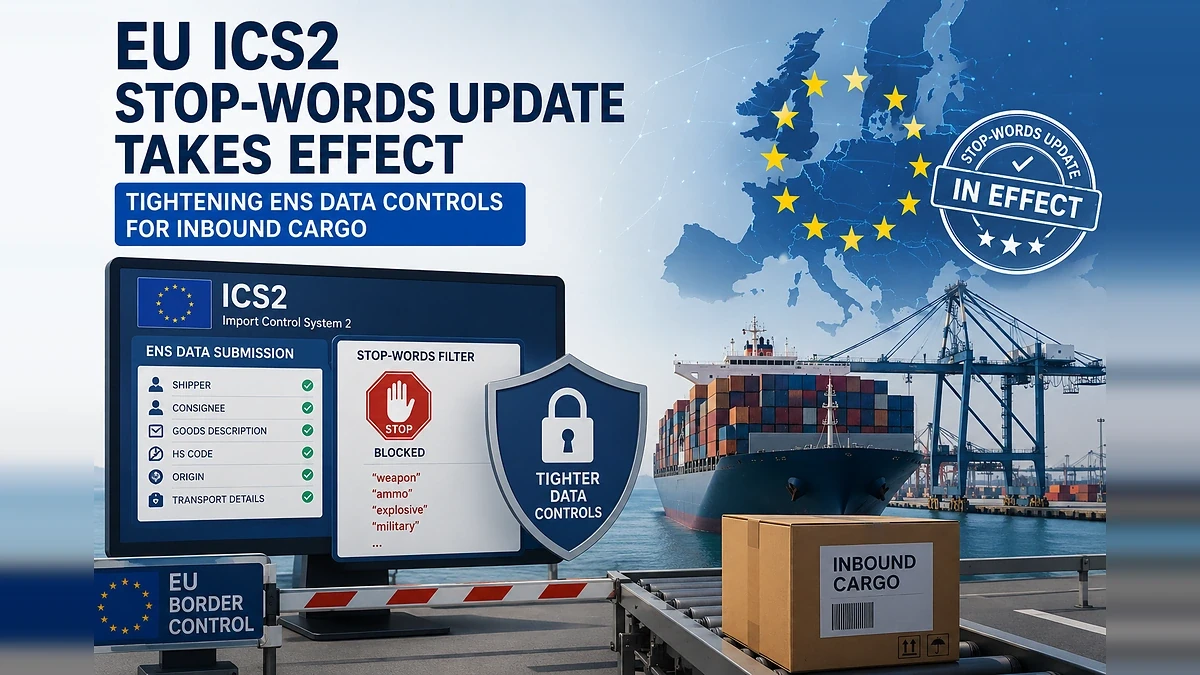
The European Commission’s updated Import Control System 2 (ICS2) stop-words list took effect on 3 August 2026. The Commission published the revised list in its CIRCABC document library on 1 July and states that all consignments entering the EU by any transport mode from 1 June 2026 should be covered by a valid Entry Summary Declaration (ENS), filed directly in ICS2 or, in eligible road and rail cases, through a combined NCTS Phase 6 declaration.
ICS2 is the EU’s advance cargo-information system for goods entering or transiting the Union. It requires economic operators to submit complete safety-and-security data before arrival. For maritime traffic, the carrier operating the sea-going vessel must also lodge the arrival notification at the customs office of first entry. The Commission says customs can reject incomplete ENS declarations, issue risk-mitigation referrals for inaccurate data, and impose administrative sanctions for non-compliance. Rejections or referrals can delay ENS processing and the cargo-entry process.
FIATA, the freight-forwarder federation, says the revised stop-word terms are treated as indicators of insufficient ENS data quality and may lead to automatic filing rejections. A carrier’s operational guidance illustrates the practical effect: where a stop word causes an ENS rejection, the shipment may be placed on hold until the goods description is corrected.
**Analysis and operational relevance**
This is principally a data-quality control change, not a new maritime customs regime. Its immediate significance is that existing shipping-instruction templates, booking portals, EDI/API mappings and house-bill data may now contain descriptions that no longer pass the applicable validation list. Generic descriptions can be particularly problematic where supply-chain parties divide ENS responsibilities through multiple filing.
Shipowners and operators calling at EU ports should confirm with their agents, NVOCCs and freight forwarders which party is responsible for each ENS data element, especially goods descriptions at house-bill level. Charterers and cargo interests should ensure that commercial descriptions supplied at booking are specific, consistent with the HS classification and available early enough for pre-arrival filings. Masters should not be expected to cure underlying cargo-data defects, but vessel arrival planning can be affected when ENS issues remain unresolved.
A prudent immediate action is to obtain the current Commission list through the official ICS2 library, compare it against master-data dictionaries and customer booking fields, and test rejection-handling workflows. Records should identify who amended a description, when, and on what documentary basis. That supports customs compliance, cargo-release follow-up and potential allocation of delay costs. The operational risk is medium: the rule update is narrow, but failures can interrupt cargo processing at the EU border.
Technology supported research and drafting. TWS retains editorial responsibility for the published content and cited sources.
Need operational support?