The Tripartite Joint Industry Working Group (JIWG), coordinated by BIMCO, has opened an industry consultation on a common digital process and data-exchange protocol for maritime emissions reporting. The consultation opened on 1 July 2026 and is scheduled to close on 15 September 2026.
**Verified development.** The proposal seeks a harmonised, open and non-proprietary framework for emissions-related data exchanged among owners, operators, charterers, verifiers, flag States, authorities, class societies, technology providers and ports. Its intended building blocks are: a standardised emissions dataset linked to the IMO Compendium on Facilitation and Electronic Business; transmission processes based on the Operational Vessel Data (OVD) standard; and Vessel Emissions Reporting formats for commercial outputs, verification status and user-defined reporting periods.
The JIWG identifies DNV’s OVD standard as a proposed practical baseline. BIMCO says OVD is supported by more than 60 stakeholders and has been operationally tested through DNV’s Veracity platform. The consultation specifically asks whether this approach works across ship types, trading patterns and business models; it is not itself a new statutory reporting obligation.
**Regulatory context.** The initiative comes as reporting workloads become more consequential. EU ETS maritime coverage now includes methane and nitrous oxide from 1 January 2026, alongside carbon dioxide. Companies must surrender allowances for 70% of their 2025 in-scope emissions during 2026; the obligation rises to 100% from 2027. EU ETS requirements operate alongside IMO DCS, EU MRV and increasingly detailed commercial, charter-party and customer emissions-information requests.
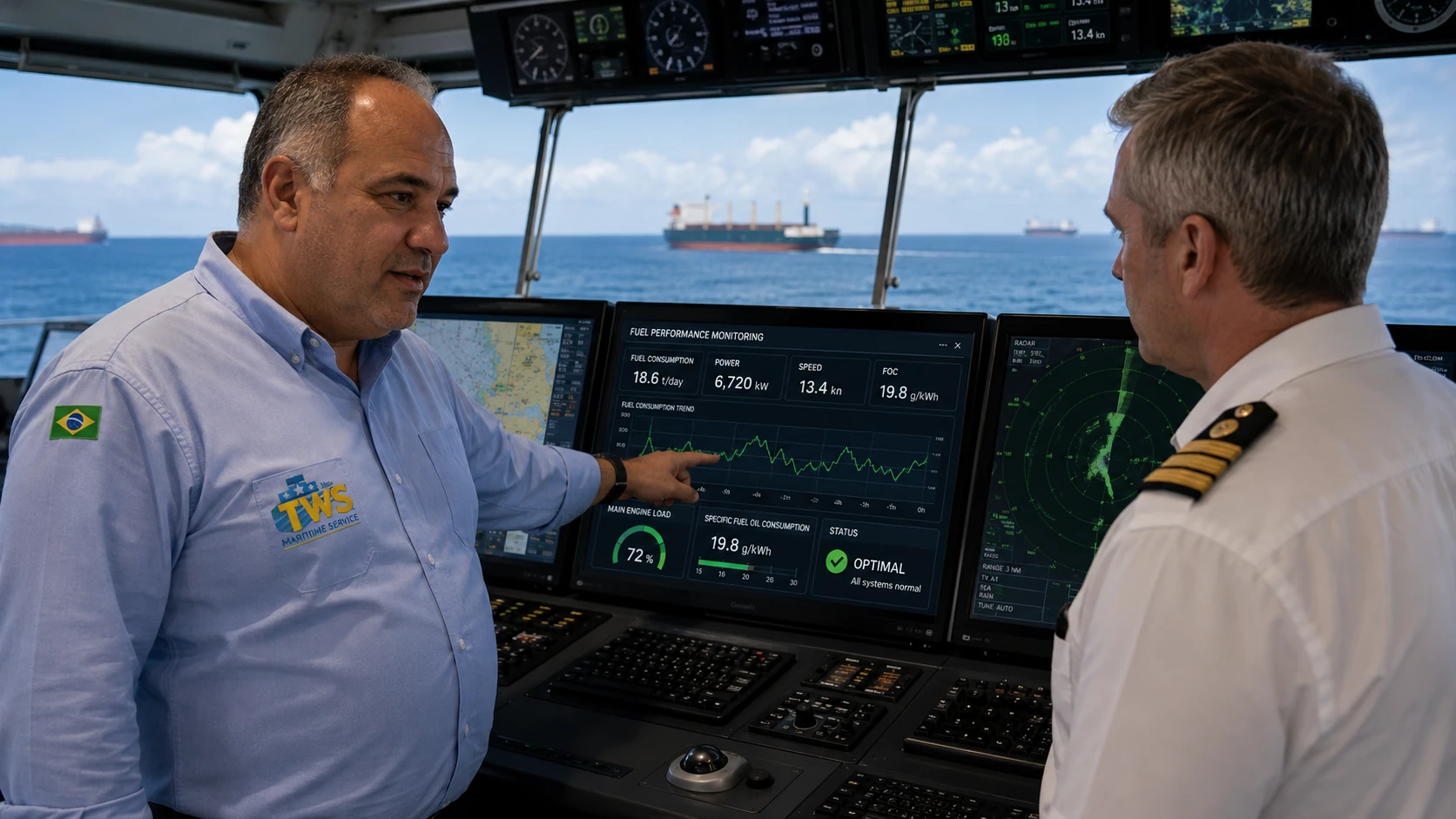
**Analysis.** A common dataset will not remove the need for robust onboard measurement, voyage-event validation or independent verification. It could, however, reduce repeated manual mapping of noon-report and log-abstract data into different owner, charterer, verifier and regulatory systems. That is operationally relevant because errors in fuel, distance, cargo, berth-time or emissions-factor fields can propagate into allowance exposure, FuelEU-related calculations, contractual performance discussions and customer carbon reporting.
**Why this matters.** Owners and operators should treat the consultation as a data-governance and controls exercise, not simply an IT standardisation project. Fleet teams can compare existing noon-report schemas, fuel-data custody, correction logs, API interfaces, verifier hand-offs and cyber-access controls against the proposed model. Charterers and cargo interests may also benefit from clearer agreement on data definitions, cut-off times, responsibility for corrections and audit rights. Early feedback is particularly useful where operational realities—such as split voyages, multiple charterers, port waits, mixed-fuel use or unreliable connectivity—are poorly represented in standard data fields.
Technology supported research and drafting. TWS retains editorial responsibility for the published content and cited sources.
Need operational support?