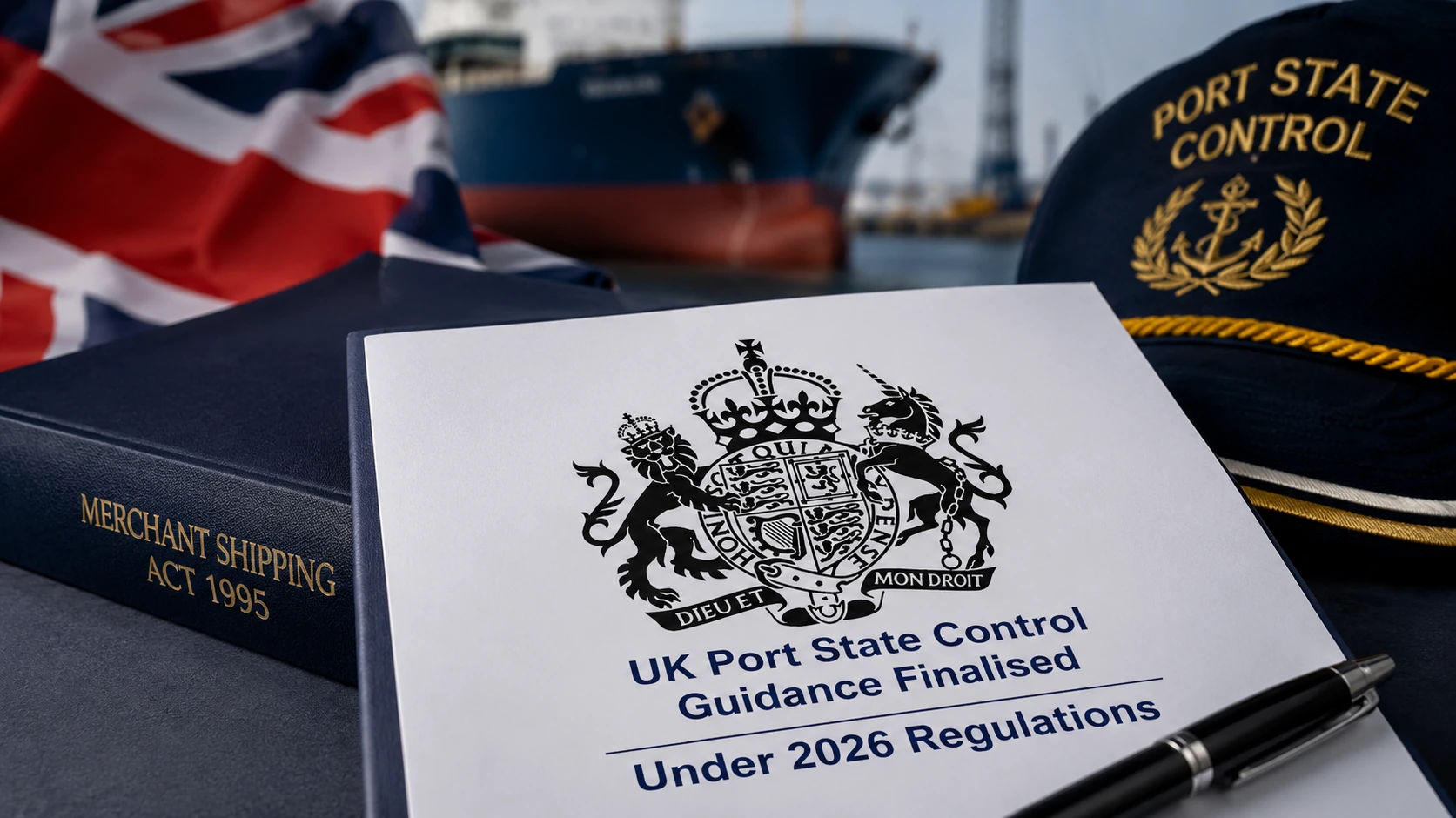
Illustrative image: port state control inspection activity on a merchant ship in port.
**Verified facts**
The UK Maritime and Coastguard Agency (MCA) finalised Marine Guidance Note MGN 711 on 22 July 2026. The notice accompanies the Merchant Shipping (Port State Control) Regulations 2026 (SI 2026/563), implements the Paris Memorandum of Understanding on Port State Control (Paris MoU) in the United Kingdom, and replaces MSN 1832(M) Amendment 1.
The regime applies to foreign-flag seagoing ships and their crews calling at UK ports or anchorages within port jurisdiction where a ship/port interface occurs. It does not apply to UK ships, fishing vessels, warships, naval auxiliaries, primitive wooden ships, foreign government ships used non-commercially, or pleasure vessels.
MGN 711 confirms that ships are assigned a high-, standard- or low-risk profile, recalculated daily using factors including ship type and age, flag performance, recognised-organisation and company performance, and deficiencies and detentions recorded during the preceding 36 months. The profile determines inspection priority, frequency and scope. Periodic inspection intervals are six months for high-risk ships, 12 months for standard-risk ships and 36 months for low-risk ships.
Expanded inspections apply to high-risk ships and to gas, oil and chemical tankers, bulk carriers and passenger ships over 12 years old at prescribed intervals. A ship selected for an expanded inspection must remain in port or at anchorage until that inspection is complete. Where deficiencies are clearly hazardous to safety, health or the environment, the MCA may detain the vessel or stop the relevant operation.
The guidance also restates that repeated detentions can trigger refusal of access to UK and other Paris MoU-member ports and anchorages. A change of owner or flag after a refusal notice does not alter its terms; repeated cases can result in permanent exclusion. UK pilots and port authorities must report apparent safety or environmental anomalies, while port authorities are expected to submit actual arrival and departure times for foreign ships within 72 hours for transfer into the PSC information system.
**Why this matters**
The final guidance is not simply a documentary update: it consolidates the operational evidence trail that can affect a vessel's inspection exposure across the Paris MoU region. Owners, managers and charterers should confirm that vessel records, statutory and class documentation, defect-close-out evidence, crew certification and onboard operational standards are inspection-ready before UK calls. For older tankers, gas and chemical carriers, bulkers and passenger ships, berth planning should allow for the possibility that an expanded inspection delays sailing.
P&I, cargo and claims interests should also treat pilot or port-anomaly reports and port-call timestamps as potentially important contemporaneous records following an incident, pollution allegation, cargo delay or detention. The Paris MoU notes that company performance and the inspection outcomes of sister vessels within the same ISM company can affect a ship's risk profile, making fleet-wide corrective action more important than a vessel-by-vessel response.
Technology supported research and drafting. TWS retains editorial responsibility for the published content and cited sources.
Need operational support?